American Kenpo Belt System: What Each Rank Asks of You
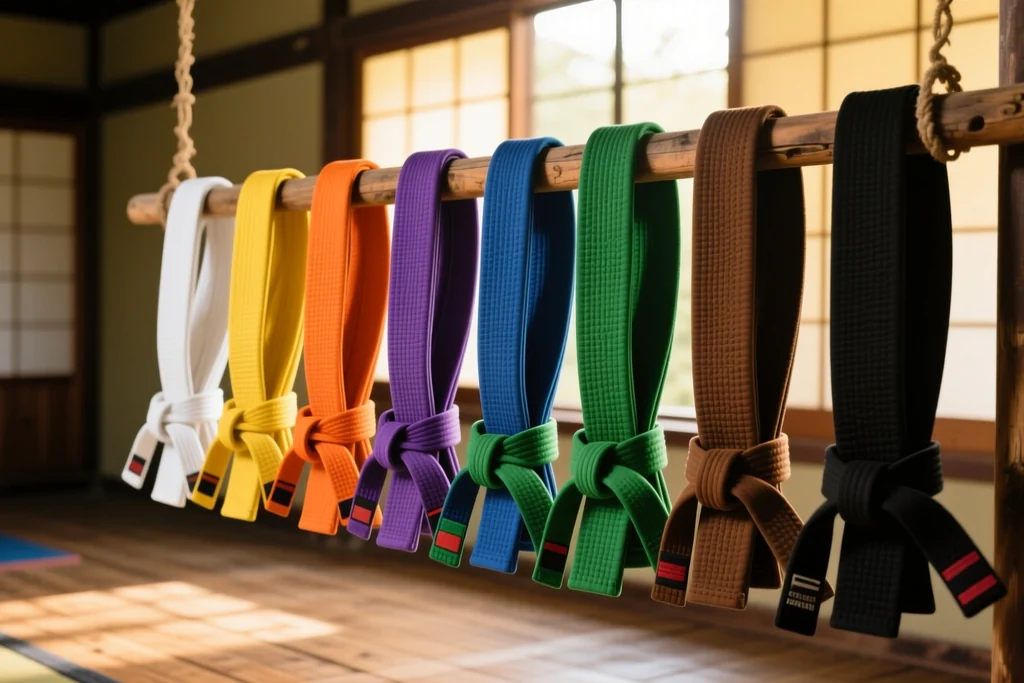
In American Kenpo the belt around your waist is not decoration: it marks how much of the system you can actually use, and how much of it you can explain. Through the Chinese Karate Federation lineage the sequence runs from white to yellow, orange, purple, blue, green and brown before the first black belt — and every step tests a defined block of basics, forms and self-defense techniques.
The ranking system also surprises newcomers more than any other part of the art. The colour logic behind it is not ancient wisdom passed down for a thousand years; it is a deliberate, modern design, and knowing where it comes from makes the whole progression easier to read.
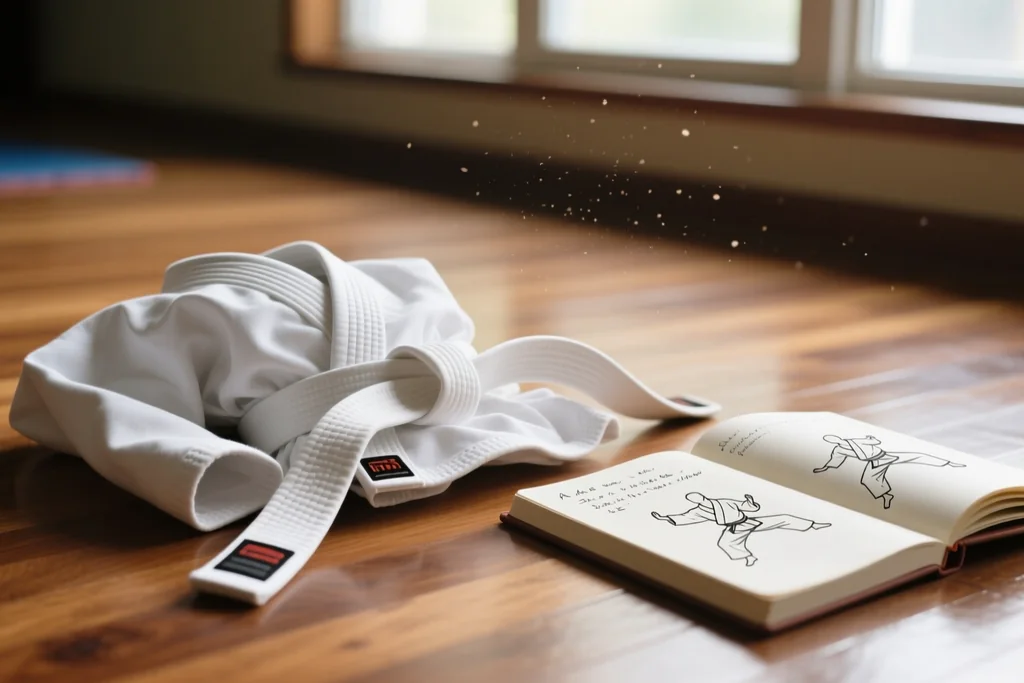
Belts are younger than most people assume
The coloured belt as we know it is a nineteenth-century invention. It was first used in the martial arts by Kano Jigoro, the founder of Judo, as a way of showing a student's progress in a system large enough to need signposts. From Japan the idea spread, and by the time American Kenpo took shape it was already the standard way of organising a curriculum.
In this art the belt signals more than time served: it marks the level of the practitioner inside the material being taught and tested, and it is only awarded once that material is demonstrated. Two students who started together can be two belts apart, because the system rewards refinement rather than attendance.
Why American Kenpo uses Chinese colours
Senior Grandmaster Edmund K. Parker, the founder of American Kenpo Karate, dug deeply into the meaning of colour in Chinese culture when he designed the ranking system. In that tradition black represents yang and white represents yin, two halves of the same cycle: black is treated as the king of colours, the colour of heaven and of beginning, while white is the end.
Classical Chinese thinking also organised the world through the five elements, and Parker borrowed that structure too: each element carries a movement, a colour, a direction and a type of energy, so the belt sequence maps onto a logic rather than onto a rainbow.
The colour sequence, step by step
Read as a whole, the progression from white to black describes how a skill is built: find the base, stabilise it, expand it, tighten it, protect it, make it produce, then combine everything. The table below sets the sequence against the job each colour describes.
| Belt | What the colour asks of you |
|---|---|
| White | The end of one cycle and the beginning of another: the first day on the mat. |
| Yellow | Stabilise what you have learned — stance, basics and the first self-defense techniques. |
| Orange | Add fire to the base and expand the vocabulary of motion. |
| Purple | Contract: tighten the technique and remove sloppy movement. |
| Blue | Conserve what you have learned and make it reliable under fatigue. |
| Green | Generate: begin to produce your own answers inside the system. |
| Brown | Combine everything from yellow to green and keep going. |
| Black | Heaven and the new beginning — the first degree, not the last. |
The colours alone mean nothing without material behind them. Each step carries its own block of basics, sets, forms, freestyle and self-defense techniques, and a student is expected to perform that block cleanly before moving on. The belt is the receipt for the work, not the work itself.
What you actually test on
In American Kenpo a student must learn certain basics, sets, forms, freestyle and self-defense techniques at each belt, and those are tested as a blueprint of motion. The physical side is only half of the exam, because students also learn the concepts and principles of Kenpo — which are built on science, primarily physics and geometry — along with rules, code words, themes, definitions and theories.
The vocabulary is practical rather than academic. A student who can name the principle behind a technique can correct himself when an instructor is not standing next to him, and speaking the language of Kenpo is what turns a follower of drills into someone who can analyse, interpret, tailor and improve the material.
Three stages: academic, sport and combative
American Kenpo in this lineage is usually described through three stages, and adults move between them at different speeds. The academic stage is the study of the material itself: technique names, principles, forms and the logic that links them. The sport stage is where the material meets another person under rules, in point sparring, continuous fighting or sport jujitsu, where timing and distance are decided by someone trying just as hard to score on you.
The combative stage takes the same tools and strips the rules away, which is where reality-based training and the harder Kenpo material belong. None of the three replaces another: a student who only studies forms struggles when someone moves first, and a student who only spars eventually hits a ceiling because the vocabulary behind the movement was never built.
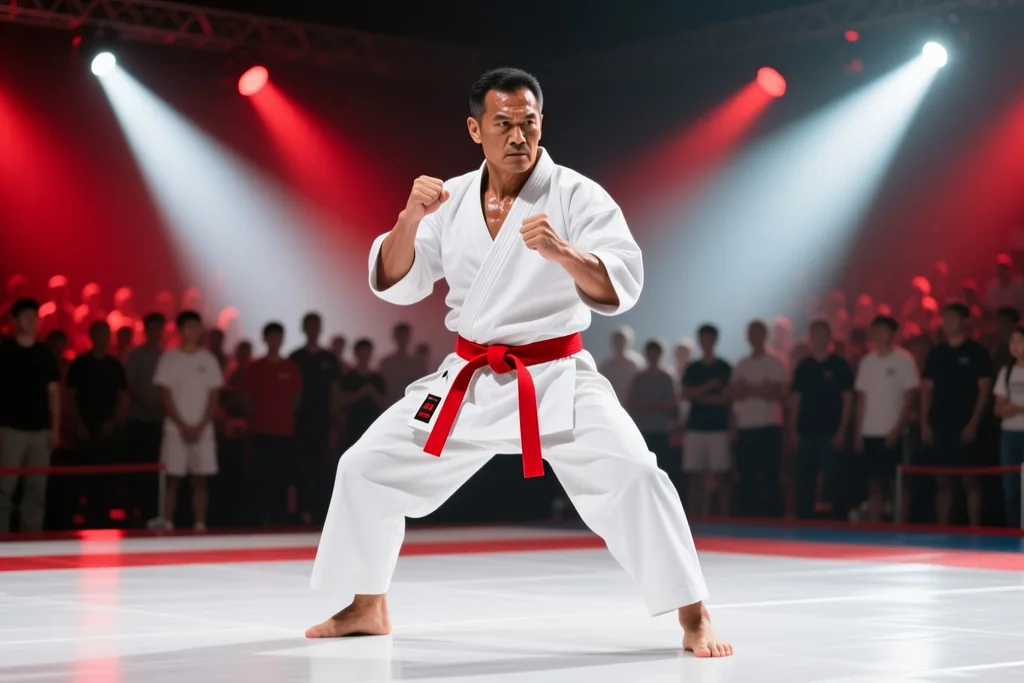
The red belt and the federation
At the top of the sequence the Chinese Karate Federation took one deliberate step away from the traditional colour code. Because every concept in Kenpo is viewed together with its opposite and its reverse, the federation reversed heaven and fire: instead of a black belt with red stripes, senior ranks wear a red belt with black stripes.
The change signifies humility, honours the wisdom of the instructors who came before, and commits the holder to being a lifetime student of the art. It is not a rank earned through a test alone — the red belt can only be presented by the President of the Chinese Karate Federation, and only for the fifth degree and above.
How to prepare for a belt test
Preparation is mostly repetition with attention. The material for the next belt should be practised until it runs without thinking about the sequence, and then practised again slowly, because speed usually hides the mistakes examiners are looking for. Adults with jobs and families do best with short, frequent sessions rather than one long session a week.
A practical checklist for the last month before a test:
- Run the full list of techniques slowly at least twice a week.
- Practise the forms and sets on their own, without a partner.
- Ask an instructor to watch one repetition and name the first thing that breaks.
- Train tired once a week — exams happen when the legs are heavy.
It also helps to ask questions out loud. Students who can explain why a move works tend to test well, because they can recover when something goes wrong. The colours and the red belt describe a path designed by people who expected a student to walk it: one block of material, one test at a time.